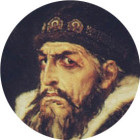
Ivan the Terrible conquered lands and used terror against his people. The following Time of Troubles nearly finished Russia as an independent state. Stability came only with the new Romanov dynasty.
Background
The 16th century saw the emergence of strong centralized states in Western Europe. The Habsburgs of Spain were the strongest. In Eastern Europe Russia became the dominant power and was constantly fighting Poland, Lithuania, Sweden and the Turks.
State and society
According to the Third Rome theory, the tsar was an absolute monarch with unlimited power who personally owned the land and people of Russia.
Tsar Ivan the Terrible significantly diminished the power of the boyars. The most prominent of them formed the Boyar Duma. There was also a parliament called the Zemsky Sobor (Assembly of the Land) whose role was limited to merely that of a rubber stamp.
Foreign relations
After the contradictory reign of Ivan the Terrible and the Time of Troubles, Poland and Sweden nearly succeeded in occupying Russia.
With the new Romanov dynasty in 1613 a long, prosperous golden age followed. Russia’s expansion to the east as far as the Pacific Ocean was completed, and a unique Russian culture developed in partial isolation from the rest of the world.
Culture
The Orthodox Church had a continuous influence in Russia’s everyday life. One of the defining events was the Schism (Raskol), which was followed by the church reform by Patriarch Nikon in 1653
1533-1584
The process of centralizing power was completed under Ivan IV (the Terrible). He expanded Russia’s territory in great magnitude and caused the death of hundreds of thousands.
Background
Ivan was 3 years old when his father Vasily III died. For the next 14 years a vicious fight for power between boyar families resulted in 14 murders, including that of his mother Elena Glinskaya.
First tsar
In 1547 the first half of Ivan IV’s reign was promising. He rewrote laws and summoned the parliament (Zemsky Sobor) in 1549.
Ivan expanded his territory to the Caucasus by conquering Khazan and Astrakhan, which were under the rule of the Mongol khans.
Terror
After the death of his wife Ivan IV changed. He became extremely paranoid and vengeful and instituted the Oprichnina (1564-72), a domestic policy of state repression and terror.
That was the tsar’s personal state. The rest of the country was called the Zemschina and was where his loyal warriors, called Oprichniki, had unlimited power to terrorize the boyars.
The wave of terror reached unimaginable heights. Some areas were entirely depopulated. The defection of Ivan’s close friend Andrey Kurbsky further worsened his mental health.
Later years
When the Crimean khan [k4] burned down Moscow in 1571 Ivan broke down and spent his last days in a monastery pleading forgiveness for his sins.
1598-1613
The weakest point in the history of the Russian state. 15 years of civil war and famine killed one-third of the population and took Russia very close to being occupied by Poland.
Background
Ivan the Terrible left two sons as heirs. The elder son, although mentally disabled, became tsar Fyodor I. The second son Dmitry was only 8 when he was discovered dead with his throat cut. Everyone blamed Fydor’s brother-in-law Boris Godunov for murder.
Time of Troubles
When Fyodor I died childless the 700-year old Rurik dynasty ended. The Time of Troubles (Smutnoye Vremya) began. Rivaling boyar families fiercely fought for power and the next 12 years saw 6 consecutive rulers murdered.
Poland, Sweden and Khazaria attacked on all sides. Famine killed one-third of the population.
Three impostors
In 1605 a Polish man declared he was the real tsarevich Dmitry and had survived the assassination attempt. He became known as the False Dmitry, claiming the throne and ruling for a year. He was removed, and the following years saw the appearance of False Dmitry II and False Dmitry III, who were both killed.
By 1610 there was a real possibility that Moscow might fall under the Polish king.
In 1610 Russia was saved by a miraculous reuniting of people inspired by the church. The peasants’ improvised army, led by Kuzma Minin and Dmitry Pozharsky, drove the Poles and Swedes out of Russia.
1613-1917
The first Romanov tsar began as a weak compromise candidate in favour of the powerful boyars. Nevertheless the Romanovs became one of the longes surviving European dynasties – 304 years.
Background
After the Poles and Swedes were driven out of Moscow a brief chance had come for the Russian nobility to peacefully settle the question of who was to be sovereign.
In 1613 the Zemsky Sobor (the parliament of boyars, merchants, warriors and priests) came together. They looked for a compromise candidate who would be at least distantly related to Ivan the Terrible.
A suitable young man was found in Moscow – Patriarch Filaret’s 16-year-old son Mikhail Romanov. He was a distant relative to Ivan the Terrible’s wife Anastasia Romanova. As a young person, and therefore politically weak, he seemed like a good candidate to everyone.
Romanov dynasty
The boyars expected Mikhail I to ensure peace and stability. That he did surprisingly well.
Tsar Alexey I regained the Ukrainian and Polish territories and Fyodor III and Sophia Alexeyevna were intellectuals who promoted Russian culture.
The rest of the 17th century was characterized by relative political and religious seclusion from the rest of the world that helped form a unique Russian mentality. This period is sometimes referred to as the true Golden Age of Russia.
1682-1725
Until the 1700s Russia was still way behind the rest of Europe. Tsar Peter I (the Great) literally dragged the country out of the Middle Ages. His reforms made Russia an international player for the first time.
Background
Peter wanted to change Russia’s backwardness. His goal was a technically advanced Russia, and for that he turned his eyes to the West.
Great Northern War
In order to open up the “window to the West” Peter needed access to ports to participate in international trade and a navy to protect them.
After extensive ship-building and industrialization Russia broke Sweden’s domination of the Baltic Sea in the Great Northern War.
Reforms
Apart from military industry Peter also revolutionized Russian society. He made Russian nobility look and act like Europeans.
He made a universal Table of Ranks that let anyone rise on a social ladder. The Boyar Duma was replaced by the Senate of his inner circle. They introduced new taxes and subdued the church under the state. The first universities, hospitals, and museums were introduced.
In 1703 Peter started the construction of his new capital St Petersburg, which was planned in the middle of a swamp near the Baltic Sea. The construction was undertaken by peasants who emptied the swamp with their bare hands and took tens of thousands of lives. The “city was built on bones“.